

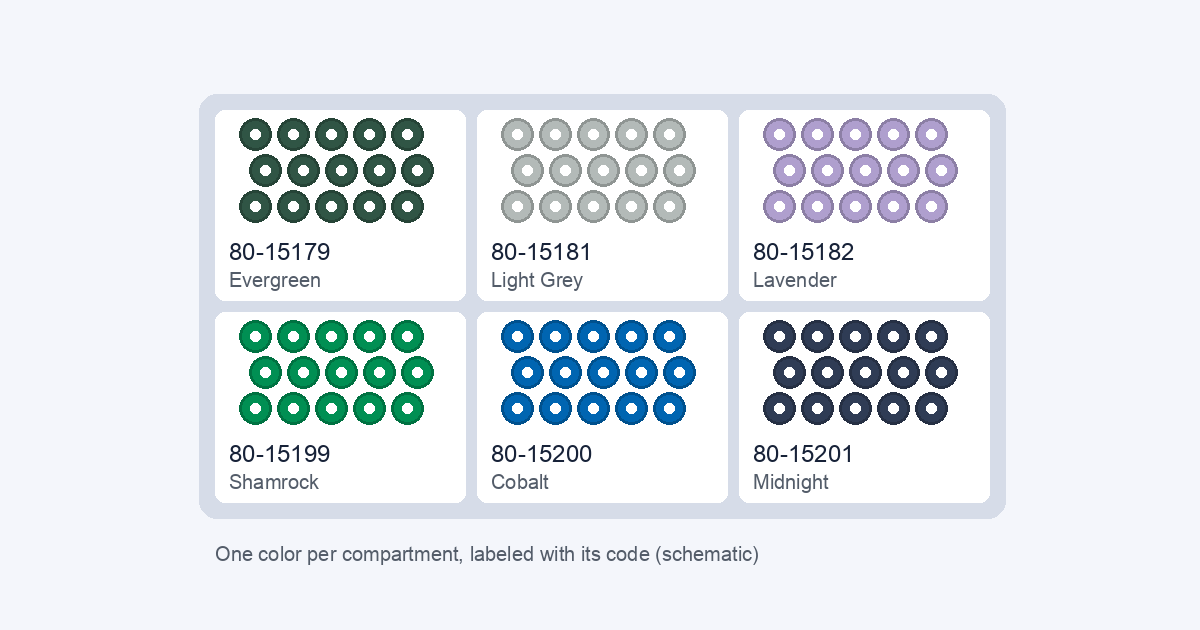
To store Perler beads in order, do three things: sort them by color, keep each color in its own closed, dry compartment (small lidded containers, a divided tray or zip bags in a box), and label each one with the color code and name, not just “green”. A label that matches your pattern’s bead list means you can pick a project, read down the list and gather beads without guessing between near shades.
Sort by color, then label by code
“Blue” is not specific enough once you own several blues, and similar shades are the ones that get mixed up. The fix is to organize by the same code your pattern uses. the pattern maker lists each color of a pattern with a name and a code, and the codes come from a community color dataset (see color data and license). A few real entries from that data:
| Code | Name | HEX on screen |
|---|---|---|
| 80-15179 | Evergreen | #305545 |
| 80-15181 | Light Grey | #B3BAB8 |
| 80-15182 | Lavender | #AF9FCE |
| 80-15199 | Shamrock | #008F53 |
A label like 80-15199 Shamrock is unambiguous; “green” could be that or Evergreen. The full list is on the Perler color chart. These are compatibility references, not an official catalog, and screen color cannot match a physical bead exactly, so if you have a physical bead in hand and a doubt, compare the bead with the chart rather than trusting the screen. If you use Hama, the Hama color chart has its own codes (the dataset lists, for example, H01 White, H03 Yellow and H04 Orange). The two code systems are separate, and this page does not claim that a Perler code and a Hama code are the same color. See Perler, Hama and Artkal compared for what differs between brands.
Practical ways to arrange colors: by hue family (reds together, blues together), then by light to dark inside each family, with neutrals (white, greys, black) in their own area. Leave a spare slot or two so a new color does not force you to re-sort everything. If you buy mixed bags, sort over a tray with a rim, working one color at a time, so a dropped handful does not scatter.
How big should each container be?
Worth a quick calculation, because a container that is too small overflows and one that is too big wastes space. Here is the math, with every assumption stated so you can replace it with your own numbers.
- Assumption (nominal size): a standard bead is about 5 mm across and about 5 mm tall, treated as a solid cylinder (the hole is ignored, which errs on the side of more room). Check your own beads.
- Bead volume = π × (2.5 mm)² × 5 mm ≈ 98.2 mm³.
- Assumption (loose packing): beads poured into a container fill about 60% of the space they sit in, so each bead uses about 98.2 ÷ 0.6 ≈ 163.6 mm³ (0.1636 mL).
- Assumption (headroom): fill a container to about 80% so the lid closes without squashing beads, so the container needs 0.1636 ÷ 0.8 ≈ 0.2045 mL per bead.
| Beads of one color | Bead space (mL) | Container size (mL) |
|---|---|---|
| 100 | 16.4 | 20.5 |
| 250 | 40.9 | 51.1 |
| 500 | 81.8 | 102.3 |
| 1,000 | 163.6 | 204.5 |
Labeled assumed example: these are estimates from the nominal size above, not measurements. For scale, a fully filled 29×29 board is 841 beads, which comes to about 138 mL of loose beads (841 × 0.1636) under the same assumptions. Different products vary in size, so one bag of your own beads is the better check: pour a counted amount (say 100) into a measuring container, read the volume, and use that number instead of 0.1636.
Keeping beads in good shape
- Closed and dry. Lidded containers keep out dust and stop colors mixing if the box tips. Avoid damp places; moisture and heat are not friends of plastic beads or of paper labels.
- Away from heat and strong sun. Leave beads away from radiators and windowsills, since heat can soften plastic and sunlight can fade colors over time.
- Static. Beads can cling to plastic containers and to each other. Pouring slowly and wiping a clingy container with a slightly damp cloth may help. This is a practical tip, not a guarantee.
- Mixed-up colors. If two colors get mixed, tip them onto a white tray and sort in good light. Dark shades (Midnight and Evergreen, say) are easy to confuse in dim light.
- Safety. Beads are small parts. Keep them away from small children and pets, and do not let anyone put them in their mouth. Follow the age and safety guidance on the packaging, and get medical advice if a bead is swallowed.
Check stock against the CSV
Once your containers are labeled by code, the CSV export from the pattern maker turns a pattern into a shopping and pull list. As the tool is built today, the CSV is a per-color bead list: a header row of palette, code, name, hex, required, then one row per color used in the pattern, ordered from the most beads to the fewest. It does not know how many beads you own and it has no total row, so the checking step is done by you in a spreadsheet or on paper. (BeadDraft does not currently have an inventory tool; the CSV is the part that exists.)
A minimal file looks like this. The numbers are an example, not a real pattern:
palette,code,name,hex,required
perler-beadcolors-v1,80-15179,Evergreen,#305545,212
perler-beadcolors-v1,80-15199,Shamrock,#008F53,148
perler-beadcolors-v1,80-15181,Light Grey,#B3BAB8,96
perler-beadcolors-v1,80-15182,Lavender,#AF9FCE,40
The real file wraps each value in quotes and starts with a byte-order mark; spreadsheets read it normally. To use it:
- Open the CSV in a spreadsheet and add a column called on hand.
- Count each color in your container (weigh a counted 100, then weigh the rest, if you have a scale) and type it in.
- Add a column short = required − on hand. Zero or negative means you have enough.
- Gather the colors you have enough of into one tray, and buy for the colors that are short.
In the example, the total is 212 + 148 + 96 + 40 = 496 beads across 4 colors. If the Evergreen container held 180, the Evergreen row would be 212 − 180 = 32 short. Using the formula above, the four example colors need about 496 × 0.1636 ≈ 81 mL of loose bead space in total, an estimate only. The chart and bead counts are also in the printed reading chart, and how colors are matched explains why the list has the shades it has.
What this page does not cover
I did not test containers, trays or storage methods for this article, and the volume figures are arithmetic on stated assumptions, not measurements. Bead sizes vary by brand and line, so recompute with your own beads. For how the fusing step works once you are ready to build, see how to iron Perler beads.