

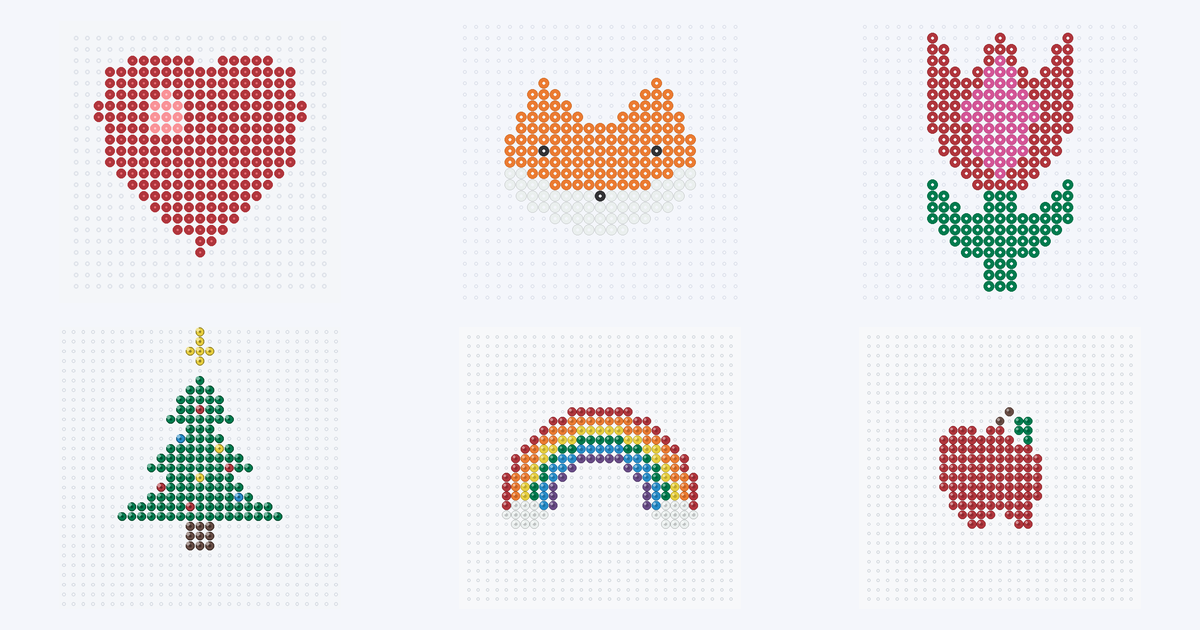
Bead patterns are instructions for arranging beads into a design. The format depends on the craft: a fuse-bead chart uses one grid cell per bead on a pegboard, while bead weaving needs instructions for rows, stitches and thread paths. BeadDraft makes fuse / Perler / melty pixel-bead patterns. Our charts and maker do not provide loom, seed-bead, brick-stitch, peyote or strung-jewelry patterns.
Think of these charts as different languages. A colored square can identify a position on a pegboard; it cannot tell you where a needle passes or how a bracelet closes. If you came looking for beading patterns, first identify the construction method. For pegboard projects, start with our free original pattern collection or the pattern maker.
Which kind of bead pattern do you need?
The distinction is how the beads are held together. Fuse beads join with heat; woven and strung beadwork uses thread or cord. Even when two designs depict the same flower, their instructions can be very different. The overview below identifies the craft, rather than teaching its stitches.
| Craft | Pattern format | Typical materials / tools | Covered here? |
|---|---|---|---|
| Fuse / Perler / melty pegboard beads | Placement chart; our square grids use one occupied cell per bead. | Fuse beads, pegboard, ironing paper and iron. | Yes: charts and maker. |
| Seed-bead loom weaving | Rows of beads, with weaving and finishing instructions. | Seed beads, loom, warp and weft threads, needle. | No loom patterns. |
| Brick / peyote stitch | Stitch-specific bead layout and thread path; not a pegboard placement guide. | Beads, beading needle and thread; no loom. | No stitch patterns. |
| Pony / kandi-style simple strung bracelets | A sequence of colors or letters, plus stringing and knot instructions. | Pony beads and elastic cord for a stretch bracelet. | No bracelet patterns. |
In loom work, beads sit between warp threads and are secured with a weft thread. Brick stitch arranges beads like a brick wall and attaches them to thread bridges. Peyote is also an off-loom technique, with its own stitching sequence. A simple strung bracelet follows a bead sequence along a cord. None of those thread paths is encoded in a BeadDraft PDF.
Sources for these basic distinctions: Perler's standard fusing method, bead weaving, brick stitch, peyote stitch, and Pony Bead Store's stretch-bracelet instructions. For our craft, the fuse-beads guide explains the pegboard workflow.
How to read a fuse-bead pattern
Read the grid left to right, top to bottom. Each occupied cell represents one bead; an empty cell stays empty. Keep the chart's orientation consistent with your board, especially for text or an asymmetric motif. Use row and column coordinates to resume after a break instead of guessing from the picture. The decorative pegboard margin in a gallery preview is not an extra row to build.
The maker's PDF starts with a materials list: color symbols, codes, names, hex values and bead counts. Match a cell's symbol to that list rather than relying only on its printed shade. The 103-shade Perler reference palette is a community-sourced compatibility reference, not an official swatch book. Screen and printer colors are approximations; compare the referenced shades with your physical beads.
Add the per-color quantities to get the total. Empty cells contribute nothing, so width multiplied by height is only the number of available positions. After painting, erasing or replacing colors in the maker, check the updated counts before setting out your supplies.
PDF chart sections contain up to 29×29 cells, with coordinate labels and a board position to help you navigate a larger design. A4 and US Letter are available. The export explicitly says READING CHART — NOT 1:1: read it beside the board, not underneath as a calibrated placement template. See the printable-pattern guide for the distinction between a reading chart and a life-size template.
How to make your own bead pattern in three steps
- Choose your input. Open the pattern maker, upload a JPG, PNG or WebP, enter a short name or message, or use the built-in orange tabby sample. For a photo, crop around one clear subject. The image-to-pixel-art guide explains why a strong outline survives reduction better than a busy background.
- Adjust width and colors, then apply. Set the grid width from 12–120 cells. For images, height follows the crop, with a 120-cell height limit. Generation uses a cap of up to 12 colors matched to the 103-shade Perler palette. Compare previews, inspect narrow strokes and small gaps, and choose “Apply this preview.” You can then paint, erase or replace colors; the pixel-art-maker guide covers working on the grid.
- Export the confirmed pattern. Open Export, choose A4 or US Letter, and download the PDF reading chart. PNG provides a grid image and CSV provides the bead list. Unapplied previews are not exported: confirm the version you want before downloading or counting supplies.
Start small and inspect the result before adding detail. A wider grid can preserve more of a silhouette, but it also creates more positions to fill. A lower color cap can simplify sorting; keep enough contrast to distinguish the important parts. These are design choices, not promises that every photograph will produce a recognizable pattern.
Make your own fuse-bead pattern →
Where to find free bead patterns here
Our free bead patterns collection contains original fuse-bead charts with grid previews and per-color quantities. Browse animals for faces and a butterfly, or flowers for a bloom, daisy, tulip and sunflower. The six motifs in this page's banner come from actual gallery previews, not a separate download pack.
Choose by the kind of project you want: easy patterns discuss beginner choices; simple shapes focus on clear silhouettes; cute patterns explore small expressive motifs. For seasonal ideas, visit Christmas patterns or the Halloween guide. These pages combine charts and guidance; they are not all downloadable pattern collections.
There is no large ready-made download library here, and no loom or seed-bead pattern library. Gallery pages are static reading references: clicking a card does not load an editable project into the maker. To export your version of a gallery motif, recreate it in the maker and verify its counts. Uploading a decorated preview as a photo can also sample the background and bead holes, so it is not an exact grid import.
Prefer original motifs and photos you made or have permission to use. Avoid copying copyrighted characters or brand artwork. A design being visible online does not establish permission to reuse it. A familiar generic subject, such as your own flower drawing or a pet photo, leaves room for personal colors and proportions without copying someone else's character.
Can you follow a chart with another bead brand?
Separate the visual layout from the physical supplies. A grid describes positions; it does not guarantee that different beads fit a board or fuse alike. Artkal labels its Midi S beads as 5 mm; Hama sells Midi beads too. Check the exact range's diameter, pegboard requirements and manufacturer's fusing instructions before adapting a design or mixing supplies. Brand names alone do not specify bead size.
BeadDraft's generator uses Perler color references and has no bead-brand or diameter switch. It does not translate those codes into Hama or Artkal codes. Match substitute colors yourself and follow the instructions for your supplies; do not treat the PDF as a compatibility certification.